

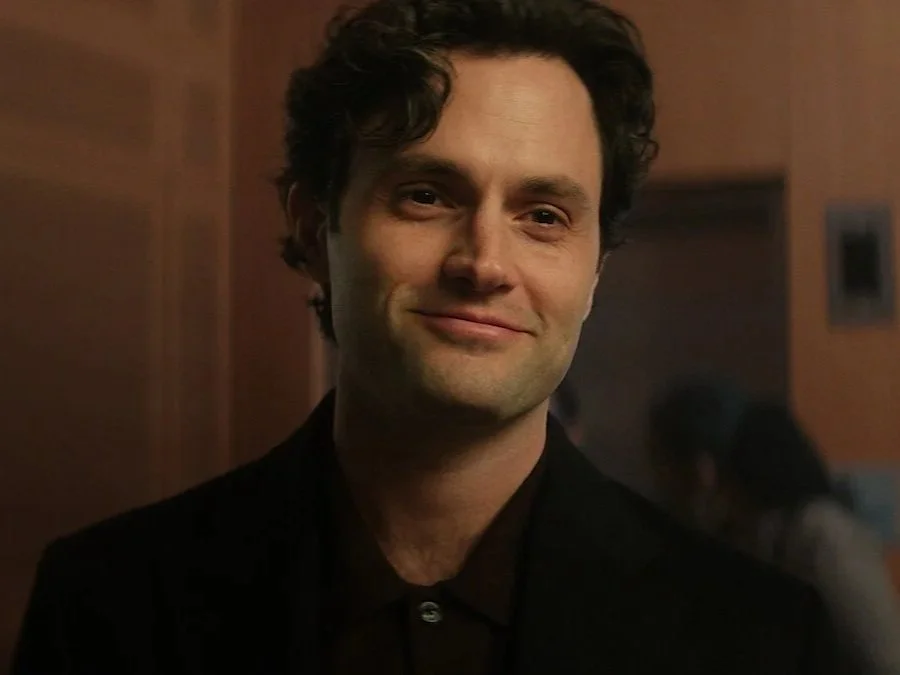
Photo by Netflix
Some villains terrify us, but some also feel a little too familiar. In this list, we’re ranking 10 INFJ villains by how much we secretly relate to them, from the most understandable to the most unsettlingly relatable.
Since our personality type doesn’t immediately top the charts on people who would inherently do bad things, I’ve also added the exact thought patterns that make them evil INFJs.
We can’t explore MBTI villains without talking about their cognitive functions. If you’re wondering why you relate to these INFJ villains, it’s all about the patterns their minds run on. Take a look at the INFJ cognitive function stack for a deeper dive.
10 INFJ Villains We Lowkey Relate To
Joe Goldberg (YOU):
We totally get what it’s like to people-watch from the sidelines and feel like we understand someone better than they understand themselves. But Joe Goldberg is basically our personality type’s worst-case scenario walking around in a stalker baseball cap, and one of the most unsettling INFJ villains on the list.
He is what happens when someone takes all our natural INFJ traits (the empathy, the intuition, the deep craving for connection) and completely weaponizes them. When you look at how his brain is wired, it’s actually scary how textbook INFJ he is.
He lives entirely in the future (Introverted Intuition). Joe sees a girl in a bookstore and immediately hallucinates their entire life together. He constantly connects invisible dots and makes huge leaps about who people are based on a single glance or a social media post. He thinks he just knows them.
He also absorbs everyone’s emotions (Extraverted Feeling). This is how he charms people. Joe can walk into a room, read the emotional temperature perfectly, and mold himself into exactly what the other person needs. The darkest part? He genuinely believes he is saving people.
His twisted empathy convinces him that his toxic actions are actually acts of care. Have you also noticed his constant voiceover? Joe’s inner logic (Introverted Thinking) is flawlessly structured to him. Every extreme, unhinged thing he does makes perfect, rational sense in his head because he’s built an internal framework to justify it all as "doing it for love". Since our shared weak spot is Extraverted Sensing, he spirals in the physical world.
When Joe gets stressed, his grand plans fall apart, and he acts impulsively. He makes messy mistakes, leaves evidence behind, and has chaotic, in-the-moment physical reactions because he gets overwhelmed by reality.
As uncomfortable as it is, we find him relatable because he mirrors the darkest, unspoken version of our own internal experience. We know that intense, all-consuming desire to find a true, soul-deep connection in a world that feels incredibly superficial. What separates us from INFJ villains like Joe is that we just, you know, choose to overthink about it in our bedrooms instead of building a glass cage in a basement.
To keep yourself grounded and avoid ever drifting into that toxic territory, just let people be messy. Remember that you cannot fix everyone, and you shouldn't try to protect people from their own life lessons. We have to stop playing the silent savior.
Also, fact-check your gut. Just because you have a strong intuition about someone's hidden pain doesn't mean it's the absolute truth. Ground your grand theories in actual, proven reality.
Lastly, use your words, and try not to mind-read. Instead of trying to anticipate exactly what someone needs and quietly orchestrating it behind the scenes, just ask them. True connection means letting the other person show up authentically, even if it ruins the perfect, idealized fantasy you built in your head.
2. Arthur Fleck / Joker (Joker 2019):
Arthur Fleck is such a heartbreakingly accurate look at what happens when an INFJ completely snaps after getting crushed by the world for too long. The reason he stands out so strongly among INFJ villains is the pure, raw pain of his empathy turning into complete nihilism.
The secret about Arthur is that he starts out as the quintessential unhealthy INFJ who just wants to bring joy to people.
He literally writes in his journal that his mother told him his purpose in life was to bring smiles and laughter to the world. That grand, sweeping sense of personal mission is our Introverted Intuition at play.
But instead of feeling connected, he experiences the ultimate INFJ nightmare. He feels completely invisible while absorbing everyone else’s cruelty. His brain copes by inventing elaborate, idealized fantasies, like imagining a warm father-son connection with Murray Franklin or hallucinating an entire romantic relationship with his neighbor Sophie.
We all know that INFJ tendency to live in our heads when reality is too cold, but Arthur’s cognitive walls completely break down. When society keeps systematically rejecting him, taking away his medication, his job, and his dignity, his Extraverted Feeling twists into something terrifying.
He goes from desperately wanting to fit into the world to realizing he can manipulate the emotional energy of the entire city. When he steps into the Joker persona, he becomes a dark symbol that galvanizes all of Gotham.
That iconic stair dance sequence is basically an INFJ hitting a full, unhinged Extraverted Sensing grip phase, where the overthinking stops and pure, chaotic, physical impulsivity takes over.
What makes him so deeply uncomfortable to watch is that any INFJ who has ever felt misunderstood, or deeply overwhelmed by the unkindness of society, sees a tiny, distorted piece of their own existential loneliness in him.
In a dark, twisted way, it’s what happens when our core need for meaningful human connection gets met with absolute coldness. And then, the door slam isn't just on one person, but on the entire world.
3. Wilson Fisk / Kingpin (Marvel's Daredevil):
Wilson Fisk is the ultimate visionary architect version of an unhealthy INFJ villain. Fisk operates like a mastermind trying to rewrite an entire city in his own image because he genuinely believes he is its savior.
The interesting thing about Fisk is that everything he does comes from a place of deep, unhealed trauma. Plus, he has a massive grand vision (like we always do).
His Introverted Intuition is laser-focused on Hell’s Kitchen. He looks at a city broken by crime and disaster, and instead of seeing what is, he sees what it could be if he just had total control. It gets paradoxical because he’s not committing crimes for money or power. He’s doing it because he unironically thinks he is the only person with the soul and foresight to fix the city.
However, his Extraverted Feeling makes him soft-spoken. He speaks in this quiet, deliberate, almost fragile tone because he feels emotions with intensity and doesn't come off as a loud, arrogant crime boss.
When he loves someone, like Vanessa, it is total, protective devotion. He opens up his entire world to her because she understands his grand vision. But when that emotional layer gets threatened, his inferior Extraverted Sensing explodes into terrifying, brutal violence.
He goes from a gentle art collector speaking softly about making the city better to smashing someone's head in a car door in a split second of absolute rage.
While this is an extreme case of an unhealthy INFJ, as an INFJ that’s been hurt, know that your deep pain doesn’t mean you should try to control every outcome. You can still practice emotional vulnerability without building massive emotional walls, and that’s where real healthy change comes from.
4. Amy Dunne (Gone Girl):
The reason Amy Dunne resonates so deeply with us, and why that ending of Gone Girl feels so weirdly satisfying, is because she is the ultimate dark fantasy of an INFJ who refuses to be taken for granted.
We all know that quiet, soul-crushing rage when you bend over backward, mold yourself into what someone else wants, and give them your absolute best, only for them to get comfortable, lazy, and betray you.
Most of us cope by slipping away and executing our classic silent door slam. But Amy looks at the door slam and says, " No, you don't get off that easily. You’re going to be forced to see me, respect me, and play the role I designed for you.
She is the INFJ villain who actually wins because she bends reality to fit her ideal narrative by locking Nick into a lifetime contract as the exact husband she demands. Sheesh!
That absolute victory comes straight down to her cognitive layout. Her Introverted Intuition is no longer just daydreaming about the future; it's mapping out a multi-step, flawless Master Plan months in advance. She foresees every narrative arc, anticipating how the media, the public, and the police will react long before anyone finds a single clue.
Her Extraverted Feeling operates like a hyper-tuned radar. She weaponizes it to perform whatever identity the world needs to see (the perfect cool girl, the tragic victim, the glowing survivor), manipulating everyone’s emotional triggers with terrifying precision.
Behind that emotional performance is her ice-cold Introverted Thinking, executing airtight, clinical logic without letting human sentimentality mess up the numbers.
And when things go off the rails? Her inferior Extraverted Sensing kicks in for high-stakes, ruthless pivoting (like that sudden, bloody box-cutter scene with Desi when she needs an immediate, physical exit strategy).
To avoid ever turning into a version of Amy, we just have to catch ourselves before the resentment curdles into control. When you feel taken for granted, state your needs directly or walk away for real. This is much better than quietly shapeshifting to please someone and then punishing them when they fail to appreciate the act.
Also, Gone Girl is just a movie, and actions like these have serious consequences. It’s much better to draw boundaries with people from the get-go. You can also let them be flawed without scripting their behavior, so you don't end up managing a dynamic instead of actually living in it.
5. Will Graham (Hannibal TV):
Will Graham hits us right in the heart because, unlike the masterminds or the vengeful tacticians, he is the ultimate tragic depiction of what happens when our hyper-empathy eats us alive.
We relate to him almost instantly because we know that exact, exhausting feeling of walking into a room, absorbing everyone’s unexpressed emotions, and having to fight to keep our own identity intact.
Will takes our classic "I understand you better than you understand yourself" trait and cranks it up to an actual curse. He steps inside criminals’ minds, feels their motivations, and carries their darkness around like it’s his own.
Watching him hide away in a house full of stray dogs in the middle of nowhere feels so painful. It is the most extreme version of an INFJ needing a total social detox just to stay sane.
His entire spiral is a terrifying exhibition of our cognitive functions being taken hostage by someone else. His Extraverted Feeling is so raw and uncontrolled that it borders on a disorder, and he cannot turn off the absorption mechanism.
Like all INFJs, his Introverted Intuition naturally wants to connect the dots and visualize the entire picture of a crime scene before anyone else even sees a clue. But because his environment is so toxic, his internal logic gets hijacked by Hannibal Lecter.
Hannibal slowly manipulates Will’s worldview, convincing him that his dark insights are his true nature and not an investigative tool. By the time Will enters his dark arc, he uses his sharp Introverted Thinking and deep planning to play a dangerously complex double game that blurs the line between catching the monster and becoming one.
Avoiding a breakdown like this comes down to protecting your energetic borders. When you feel someone else’s heavy emotions or toxic energy washing over you, you have to actively remind yourself: This is theirs, not mine.
You cannot let your ability to understand someone's dark choices convince you that you have to take on their weight or change who you are to fix them.

6. Count Dooku (Star Wars):
Count Dooku is the idealist who grew so utterly exhausted by the hypocrisy of a broken system that he decided to tear the whole thing down. We relate to him because every single INFJ knows that deep, soul-weary disappointment when an institution or workplace you once believed in turns out to be corrupt and blind to its own flaws.
Dooku left the Jedi Order because he saw the Republic decaying from the inside out and realized the Jedi were too complacent to fix it. He is that part of our INFJ minds that gets completely disillusioned with the world's politicking and feels that quiet reform is a waste of time.
His Introverted Intuition saw the galaxy's long-term trajectory long before anyone else. He foresaw the Republic's inevitable collapse and the Jedi Council's blind spots. His Extraverted Feeling is what originally drove his idealism and concern for the galaxy's future, but once he felt betrayed by the system, he weaponized it.
He became a master diplomat who used his charm, eloquent speeches, and aura to unite thousands of star systems under the Separatist banner.
Underneath that statesman exterior sat his hyper-rational Introverted Thinking, which convinced him that joining forces with Darth Sidious was simply a necessary tactical compromise to achieve a better galactic order.
But because he was so blinded by his grand vision, he completely missed the immediate, visceral trap Sidious was laying for him. There’s a lot to learn from here, though. We have to catch ourselves when cynicism starts dressing itself up as wisdom. Idealism is a gift, but the moment you start believing the end justifies any dark means, you become the very thing you set out to fix.
7. Mysterio / Quentin Beck (MCU):
Quentin was a brilliant creator whose life's work (B.A.R.F. technology) was reduced to a punchline by Tony Stark. He taps directly into our secret desire to be truly recognized for our foresight and creativity.
Beck hits on that bitter, hyper-specific feeling when your genius is ignored. We relate to him because every INFJ knows the quiet frustration of pouring your soul into creating something profound, only to watch someone else take the credit.
His INFJ villainous arc starts when his core functions get completely corrupted by ego and validation-seeking. While his Introverted Intuition was crafting a grand narrative to construct a brand-new heroic mythos, his Extraverted Feeling still made him terrifyingly effective as a mentor to Peter Parker.
He immediately senses Peter's emotional vulnerabilities, grief, and desire for a father figure. And guess what? He perfectly adapts his demeanor to become the exact compassionate big brother Peter needs.
Underneath that warm facade sits his hyper-calculating Introverted Thinking, where he manages a whole underground syndicate of disgruntled ex-Stark employees to execute a multi-layered, illusory production without a single visible seam.
But just like other unhealthy INFJs, his downfall is his inferior Extraverted Sensing. He gets so intoxicated by the grand spectacle and public adoration that he overlooks the actual, immediate physical realities of the drones around him. And that leads directly to his own defeat.
8. Melisandre (Game of Thrones):
We relate to Melisandre because every INFJ knows that intense, driving desire to serve a destiny bigger than ourselves… to feel like we are part of some grand, universal plan. What’s relatable is that she is genuinely, wholeheartedly (in her mind) trying to save the world from absolute darkness.
We INFJs get that feeling of looking at a chaotic world and desperately wanting to believe there is a divine blueprint underneath it all that makes sense of all the pain. Her entire tragic path, however, is a cautionary lesson in what happens when our functions become rigid dogmatism.
She receives symbolic visions in the flames (her Introverted Intuition), but instead of holding them lightly, she leaps to absolute conclusions. She decides Stannis Baratheon must be the chosen savior.
She is also an exceptionally powerful, persuasive spiritual leader who can sway kings, command armies, and inspire fanatic devotion (her Extraverted Feeling), but she uses that emotional influence to manipulate people into horrific acts for the "greater good."
Her Introverted Thinking is cold, absolute, and utterly detached from human empathy when it comes to her mission. She rationalizes burning innocent people because she believes a few drops of royal blood might save millions.
But her downfall comes from her total disconnect from reality (her inferior Extraverted Sensing). She was oblivious to the horror of her actions until the snow melted, they lost the battle, and the truth crushed her prophecy.
Liking this article? Join our Introvert Club→
9. Zaheer (The Legend of Korra):
Zaheer hits a unique nerve for us because he is the INFJ villain who is genuinely, deeply spiritual and actually practices what he preaches. Most villains are driven by power, revenge, or ego, but Zaheer has zero interest in ruling anyone.
We relate to him because once in our lives as INFJs, we’ve looked at corrupt politicians and oppressive systems and thought, the world would be so much better off without many societal structures. Zaheer embodies our absolute disgust with institutional hypocrisy and our idealistic craving for a world that’s rooted in natural balance.
Zaheer spent years studying ancient philosophy and the airbending guru Laghima. His mind could picture things on a cosmic scale (Introverted Intuition), where he sees an unnatural constraint on the human spirit. And once his vision of true anarchy locked in, nothing on earth could shake it.
Zaheer can sit in a cell or speak to Korra with such quiet, serene empathy that you almost forget he’s holding the entire world hostage. This is because of his Extraverted Feeling. He’s not trying to dominate or lead the Red Lotus team with fear. He genuinely respects, loves, and treats them as equals. That’s why his warmth and calm, philosophical tone can make us almost forget he’s a villain.
His logic is also relentlessly consistent (Introverted Thinking). Zaheer has a precise, airtight internal framework where he believes chaos is the natural order. If a ruler exists, they are an obstacle to freedom, so removing them is simply a logical necessity. There is no personal malice in his violence… just pure, cold execution of his principle.
Usually, an unhealthy INFJ gets tripped up by the physical world (Se), but Zaheer unlocked literal flight by letting go of all earthly attachments when the love of his life died. He used our ultimate weakness (detachment from physical reality) and turned it into his ultimate power.
But radical freedom sounds beautiful in theory because human beings need structure, safety, and community to survive. When you feel that intense urge to completely blow up a situation, relationship, or system because it feels oppressive, remember that true transformation requires building something better, not just burning down what is.
10. Thanos (MCU):
Thanos is one villain you can’t seem to wrap your head around because he carries himself like a weary, heavy-hearted prophet who is just doing a job nobody else has the strength to do. We immediately pick up on why he doesn't feel like a villain at first glance. There’s no cartoonish evil laugh, no theatrical cruelty, and no rage.
He speaks in this quiet, measured, deeply respectful tone… even to the people fighting him. He tells Wanda, "I understand, my child,” right before taking the Mind Stone, and he tells Tony he hopes they remember him. He radiates this intense, calm conviction that comes from someone who genuinely believes he is bearing the emotional weight of the universe on his own shoulders.
That presence is INFJ core on a cosmic scale, though heavily flawed and unhealthy. Thanos is obsessed with a singular, macro-level vision (Introverted Intuition) because he experienced the extinction of his home planet, Titan, when no one listened to his warnings.
That trauma locked his Ni onto a belief that the finite resources on Earth needed a halved population to survive. He zooms out to the next million years of cosmic balance, and is so fixated on his overarching vision that he doesn't see individual lives anymore.
His empathy is real, but completely twisted. When he snaps his fingers, he does it out of what he views as mercy, and not out of hatred. He truly believes he is preventing universal suffering.
When he has to sacrifice Gamora on Vormir, he genuinely loves her and isn't faking those tears. But his warped Fe tells him that his personal grief is a necessary price to pay for saving millions of lives.
His logic (Ti) is also detached and unyielding. His math is simple and cold. 50% of the population equals 100% sustainability. In his mind, he considers his method fair because it doesn't favor the rich or powerful.
He actually retires when the job is done (Inferior Se). Most villains want to conquer, rule, or parade their power to everyone. But Thanos snaps his fingers, destroys the stones so no one can undo it, and immediately moves to a quiet farm to sit in the sun and watch the sunset (which is so INFJ). He really just wanted to complete the mental script his Ni created.
But we have to remember that doing the hard thing doesn't automatically mean you're doing the right thing. INFJs can fall into this martyr trap where we assume that if a decision causes us immense personal strain or pain, it must be noble and correct. The lesson here is that sometimes, we just have to step back and realize that a singular perspective is probably not the absolute truth.
Live Your Best Quiet Life

Get the Am I Too Quiet? book →
At the end of the day…
The reason these INFJ villains hit so hard is that they help us see what happens when empathy, intuition, and idealism get pushed into unhealthy extremes.
They show how the same traits that make INFJs thoughtful, loyal, and deeply perceptive can also become dangerous when they’re twisted by pain, resentment, or delusion.
The aim of this article isn’t to make you despise your traits. It’s to help you keep them grounded and human. Because when INFJs stay connected to reality and lead with compassion instead of control, they become some of the most powerful forces for good.
Loved this article? Share it with an INFJ person who needs to read it.
You Might Also Like

See more →






If you are searching for how to calm down, remember that you need to take one gentle step or one calm thing to help you feel safer and more grounded at that moment.